日本語
日本語 한국어
한국어 Français
 Deutsch
 Español
 Italiano
 Português
 Việt Nam
 Türkçe
 عربي
عربي  русский
  Čeština
 ไทย
ไทย Eesti
Eesti Gaeilgenah Éireann
 Bai Miaowen
 íslenska
 Cymraeg
 Български
 اردو
اردو Polski
 hrvatski
 українська
 bosanski
 فارسی
فارسی Lietuvių
 Latviešu
 עברית
עברית România limbi
 Ελληνικά
 dansk
dansk magyar
 Norsk
Norsk suomi
suomi Nederlands
 Svenska
 slovenčina
 slovenščina
 हिंदी
हिंदी Indonesia
 Melayu
 Malti
Malti Kreyòl Ayisyen
 Català
 বাংলা
বাংলা Srbija jezik (latinica)
 O'zbek

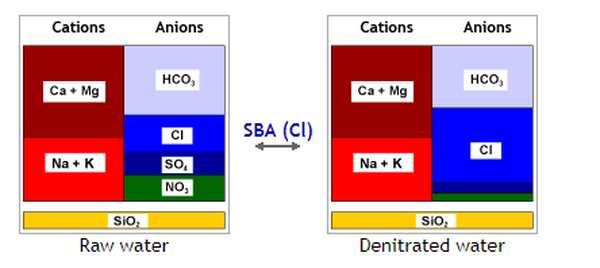
Ion exchange treatment of nitrate removal is a process that involves the exchange of ions between a solid resin and the nitrate ions in water. This technique is often used to reduce nitrate levels in drinking water and industrial wastewater.
In the ion exchange process, a resin is used which has a negative charge on its surface. Nitrate ions, which are negatively charged, are attracted to the resin surface. The resin then exchanges nitrate ions for other ions present in the water, such as chloride or sulfate. This leaves the water with lower levels of nitrate, making it safer for consumption.
The ion exchange process is highly effective at removing nitrate from water, and has a number of advantages over other treatment methods such as reverse osmosis or activated carbon filtration. It is highly efficient, allowing for the removal of up to 95% of nitrate ions in water. It is also cost-effective, with low operating costs and low maintenance requirements.
One of the key benefits of ion exchange treatment is that it does not produce any waste products. Unlike reverse osmosis, which produces a concentrated brine solution that must be disposed of, ion exchange only produces treated water. This makes it a more environmentally friendly option for nitrate removal.
Ion exchange treatment is also highly customizable. The type of resin used can be tailored to the specific water source and nitrate levels, ensuring optimal performance. It can also be combined with other treatment processes, such as UV disinfection or pH adjustment, for even greater effectiveness.
The ion exchange process is not without its limitations, however. It is only effective for the removal of nitrate ions, and does not remove other contaminants in water. It also requires a significant amount of space and can be difficult to scale up for large treatment facilities.
Overall, ion exchange treatment of nitrate removal is a highly effective and cost-efficient process for reducing nitrate levels in water. This environmentally friendly option has many advantages over other treatment methods and can be tailored to specific water sources and nitrate levels for optimal performance.