
 日本語
日本語 한국어
한국어 Français
 Deutsch
 Español
 Italiano
 Português
 Việt Nam
 Türkçe
 عربي
عربي  русский
  Čeština
 ไทย
ไทย Eesti
Eesti Gaeilgenah Éireann
 Bai Miaowen
 íslenska
 Cymraeg
 Български
 اردو
اردو Polski
 hrvatski
 українська
 bosanski
 فارسی
فارسی Lietuvių
 Latviešu
 עברית
עברית România limbi
 Ελληνικά
 dansk
dansk magyar
 Norsk
Norsk suomi
suomi Nederlands
 Svenska
 slovenčina
 slovenščina
 हिंदी
हिंदी Indonesia
 Melayu
 Malti
Malti Kreyòl Ayisyen
 Català
 বাংলা
বাংলা Srbija jezik (latinica)
 O'zbek
Hey there! I'm an ion exchange resin supplier, and today I wanna talk about how to calculate the selectivity coefficient of ion exchange resin. It's a pretty important concept if you're into using these resins, whether it's for water treatment or other industrial applications.
First off, let's understand what the selectivity coefficient is. In simple terms, it shows how an ion exchange resin prefers one type of ion over another. Different ions have different affinities for the resin, and the selectivity coefficient helps us quantify this preference.
Let's say we have two ions, Ion A and Ion B. When they're in a solution and come into contact with the ion exchange resin, the resin will exchange its counter - ions with these ions. The selectivity coefficient, usually denoted as (K_{A}^{B}), tells us which ion the resin likes more.
The basic equation for calculating the selectivity coefficient is based on the law of mass action. Suppose we have an ion exchange reaction like this:
(nR - B+A\rightleftharpoons R_{n}-A + nB)
Here, (R - B) represents the resin with ion (B) attached, and (A) is the incoming ion. After the reaction, we get (R_{n}-A) (resin with ion (A) attached) and (nB) (ions of (B) released into the solution).
The selectivity coefficient (K_{A}^{B}) is calculated as:
(K_{A}^{B}=\frac{[A_{R}][B_{S}]^{n}}{[B_{R}]^{n}[A_{S}]})
Where ([A_{R}]) and ([B_{R}]) are the concentrations of ions (A) and (B) on the resin, and ([A_{S}]) and ([B_{S}]) are the concentrations of ions (A) and (B) in the solution. The exponent (n) is the stoichiometric coefficient from the ion exchange reaction.
Now, let's talk about how to measure these concentrations. To find the concentration of ions on the resin, we usually have to do some lab work. One common method is to first equilibrate the resin with the solution containing the ions. Then, we separate the resin from the solution. We can use techniques like elution to remove the ions from the resin. After that, we can analyze the eluate using methods such as atomic absorption spectroscopy or ion chromatography to determine the ion concentrations.
For the ion concentrations in the solution, we can directly take a sample of the solution before and after the ion exchange process. Then, we use the same analytical techniques to measure the ion concentrations.
It's important to note that the selectivity coefficient can be affected by several factors. Temperature is one of them. Generally, as the temperature increases, the kinetic energy of the ions increases, which can change the affinity of the ions for the resin. Also, the ionic strength of the solution matters. A high - ionic - strength solution can shield the charges on the ions and the resin, affecting the ion - resin interactions.
Let's take a practical example. Suppose you're using ion exchange resin for water softening. In water softening, we usually want to remove calcium and magnesium ions ((Ca^{2 +}) and (Mg^{2+})) and replace them with sodium ions ((Na^{+})). The ion exchange reaction can be written as:
(2R - Na+Ca^{2+}\rightleftharpoons R_{2}-Ca + 2Na^{+})
Here, (A = Ca^{2+}), (B = Na^{+}), and (n = 2). The selectivity coefficient (K_{Ca}^{Na}) will tell us how well the resin can preferentially exchange calcium ions over sodium ions.
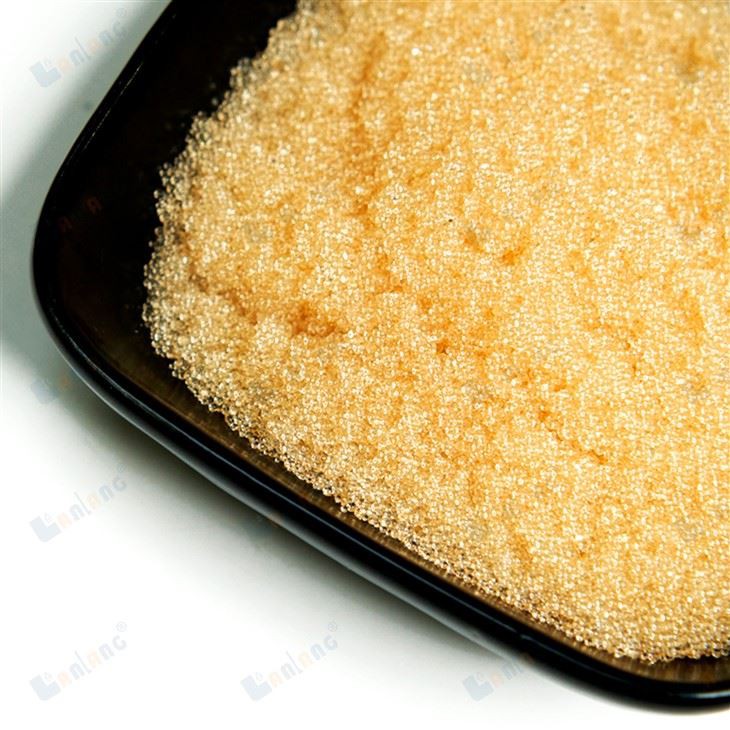
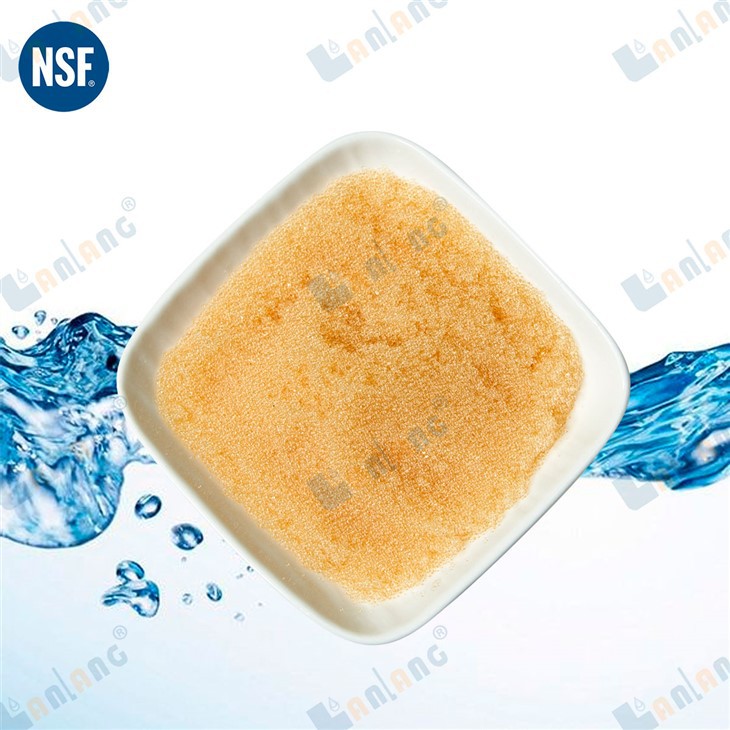
If you're in the market for high - quality ion exchange resins for water softening and demineralization, you might want to check out our Lanlang TC007 Gel Type Strong Acid Cation Exchange Resin For Water Softening And Demineralization. This resin is specifically designed to handle the ion exchange process in water treatment effectively.
Another great option is our Lanlang 001x7 Strong Acid Cation Exchange Resin. It has a high exchange capacity and good selectivity for different cations, making it suitable for a wide range of applications.
For those in the drinking water and beverages industry, our Drinking Water Beverages Ion Exchange Resin is a top - notch choice. It can help maintain the right ion balance in the water used for beverages, ensuring the quality and taste of the final product.
Calculating the selectivity coefficient can also help you optimize your ion exchange process. By knowing which ions the resin prefers, you can adjust the operating conditions, such as the flow rate of the solution through the resin bed and the regeneration frequency.
For instance, if the selectivity coefficient shows that the resin has a very high preference for a particular ion, you might be able to reduce the amount of resin needed for the ion exchange process. On the other hand, if the selectivity is low, you might need to use more resin or change the operating conditions to achieve the desired ion exchange efficiency.
In conclusion, understanding and calculating the selectivity coefficient of ion exchange resin is crucial for getting the most out of your ion exchange processes. Whether you're in water treatment, the food and beverage industry, or any other field that uses ion exchange resins, having this knowledge can save you time and money.
If you're interested in learning more about our ion exchange resins or want to discuss your specific needs, don't hesitate to reach out. We're here to help you find the best resin solutions for your applications. Let's start a conversation about how we can work together to meet your ion exchange requirements.
References
- Helfferich, F. Ion Exchange. McGraw - Hill, New York, 1962.
- Dorfner, K. Ion Exchangers: Properties and Applications. Walter de Gruyter, Berlin, 1991.